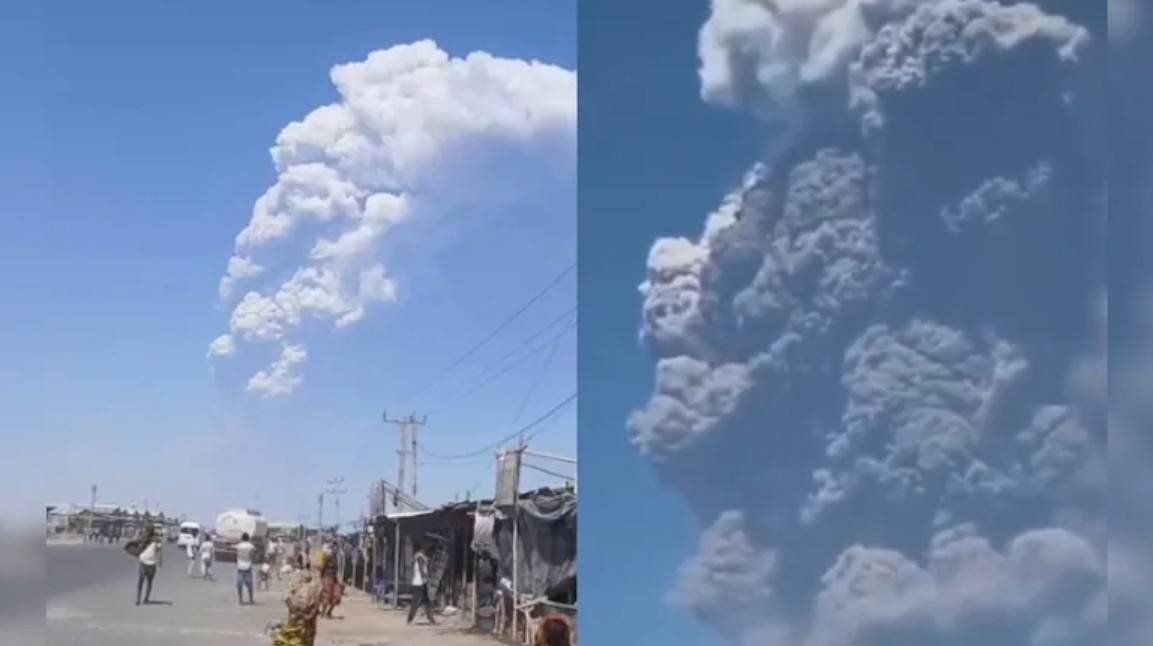
Hayli Gubbi’s massive ash plume drifts into northern India, triggering aviation warnings and haze over Delhi as DGCA issues safety advisory.
Volcanic Ash From Ethiopia Reaches Delhi
A thick cloud of volcanic ash from Ethiopia’s Hayli Gubbi volcano has reached Delhi, worsening an already critical air pollution situation, according to meteorological and aviation authorities.
The volcano, located in the Afar region, erupted for what may be the first time in thousands of years, sending ash plumes up to 14 km high.
Winds have carried the ash across the Red Sea and into India, passing through Gujarat, Rajasthan, and then moving over Delhi, Punjab, and Haryana.
Aviation on High Alert
- The DGCA (Directorate General of Civil Aviation) has issued a strong advisory asking airlines to avoid flight routes or altitudes affected by the ash cloud.
- Airlines like Akasa Air, IndiGo, Air India, and KLM have cancelled or diverted several flights due to the risk posed by the ash plume.
- Pilots have been instructed to report any “suspected ash encounter,” including strange engine behaviour or odors in the cabin.
What’s in the Ash Cloud
Experts say the volcanic plume contains fine ash, sulfur dioxide, and glass-like rock particles — a dangerous mix for aircraft engines.
The cloud is mostly flying at very high altitudes — between 25,000 and 45,000 feet — which means its effect on air quality on the ground might be limited.
Impact on Delhi’s Air Quality
- Delhi’s AQI (Air Quality Index) remains “very poor,” but experts suggest that the volcanic ash might not significantly worsen pollution levels because the plume is at high altitude.
- IMD and environmental scientists caution that while the ash layer may create a hazy sky, surface-level air pollution spikes are unlikely.
- However, some experts warn of possible impacts in hilly regions like Himachal Pradesh or Uttar Pradesh’s Terai belt, where sulfur dioxide and ash may interact with local weather patterns.
Key Implications of the Ash Cloud
- The ash cloud poses a significant risk to aviation safety, as volcanic ash can damage engines and critical aircraft systems.
- Even though its impact on surface-level air quality may be limited, the ash adds a new hazard to Delhi’s already fragile air-pollution scenario.
- Authorities will need to closely monitor both airspace and air quality, balancing immediate aviation concerns with public health risks.